
What It Means for Tokenized Assets to Actually Work Onchain

Over the past few years, real-world asset tokenization has moved from theory to production. Across capital markets, asset managers and financial institutions have demonstrated that assets can be represented on a blockchain network as digital tokens using blockchain technology at meaningful scale.
That question is settled.
The harder question is what happens next. Because many tokenized assets still behave more like digital certificates than functional financial instruments. They exist on a public blockchain. They represent ownership. But they often fail to integrate into decentralized finance in ways that improve liquidity, capital efficiency, or access.
In capital markets, assets are not endpoints. They are inputs.
They are meant to circulate, to serve as collateral, to support financial transactions, and to unlock liquidity. If tokenized real-world assets are going to deliver real-world value, they must function inside markets, not just exist onchain.
Tokenization puts assets onchain. Markets are what make them work.
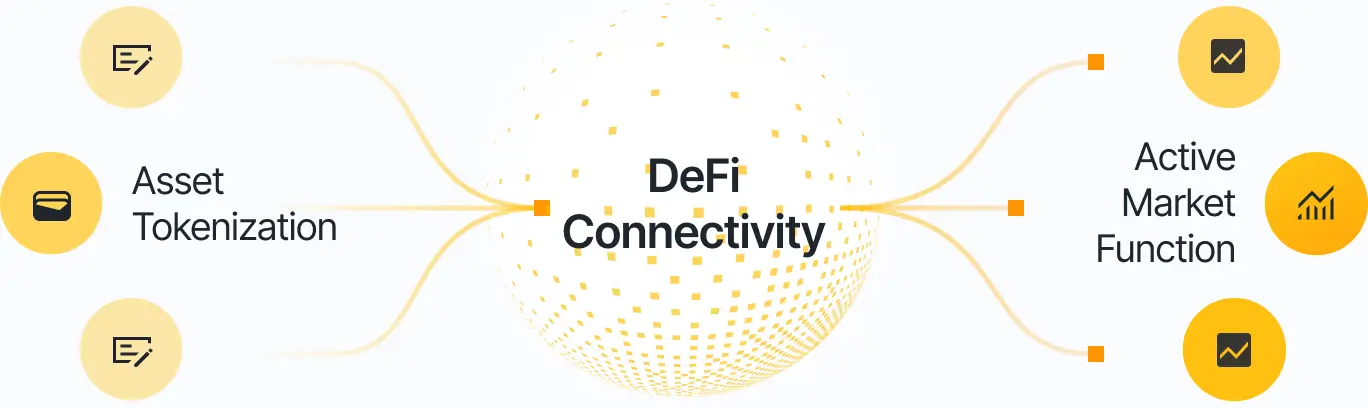
From Asset Tokenization to Function
Asset tokenization involves representing ownership rights of real-world assets as digital tokens on a blockchain network. These digital assets are created through smart contracts, which encode token issuance, ownership transfer, lifecycle management, and compliance logic directly into programmable code.
This process enables fractional ownership, global access, and improved transparency. A single underlying asset, whether private equity, money market funds, real-estate, carbon credits, or intellectual property, can be divided into digital tokens that represent ownership interests and can be transferred peer-to-peer.
But representation alone does not equal utility.
Without integration into decentralized finance protocols, secondary markets, and collateral frameworks, tokenized assets remain largely static. They may improve reporting and global access, but they do not yet function as active market instruments.
Real markets enable:
- Borrowing and lending without forced sales
- Increasing liquidity for historically illiquid assets
- Continuous transactions beyond traditional finance hours
- Broader access to institutional-grade financial instruments
This is where DeFi utility for tokenized assets becomes essential.
Decentralized finance is not simply an alternative venue. It is the infrastructure layer that transforms asset tokenization into active market behavior.
Case Study: Centrifuge’s Lending Markets in Practice
The shift from representation to function is already happening.
Through Centrifuge’s real-world asset tokenization infrastructure, institutional capital in credit and treasury strategies is brought onchain in a way that preserves regulatory compliance and governance standards while enabling market participation.
In lending markets built on Morpho, the Anemoy Tokenized Apollo Diversified Credit Fund (ACRDX) is used as collateral inside an isolated pool. Loan-to-value ratios, liquidation thresholds, and asset-specific parameters are defined at the market level. Investors can access liquidity without selling the underlying asset, while risks involved remain contained to that specific pool.
In parallel, the Janus Henderson Anemoy AAA CLO Fund (JAAA) and Janus Henderson Anemoy Treasury Fund (JTRSY) operate within Aave Horizon, an institutional-oriented borrowing environment. Access controls and collateral eligibility reflect regulatory compliance requirements rather than open cross-collateralized DeFi models.
These are not synthetic assets. They are tokenized real-world assets functioning as collateral within decentralized finance protocols under enforceable constraints. The result is behavioral change.
Assets that previously served only as yield-bearing holdings now support liquidity management, refinancing strategies, and capital efficiency directly onchain.
Making Tokenized Assets Circulate
For liquidity to persist, assets must be able to trade beyond isolated lending environments.
In traditional finance, secondary markets provide price discovery, continuous liquidity, and distribution beyond initial issuance. Without them, assets remain confined to their primary context and market depth cannot develop.
Early real-world asset tokenization models often solved issuance but left distribution fragmented. Tokenized assets were tightly bound to their original venue. Transferability was restricted. Liquidity was siloed. Separating issuance from distribution changes this dynamic.
Through asset tokenization combined with distribution architecture such as Centrifuge’s deRWA model, institutional-grade tokenized assets can move beyond their original issuance context and integrate with decentralized exchanges, DeFi platforms, and secondary markets where liquidity already exists.
The underlying asset remains governed within its regulatory compliance framework. But the distribution layer becomes programmable.
Tokenized assets can be traded continuously on decentralized exchanges via automated market makers. Transactions settle without limited hours. Global access expands participation. More investors gain access to real-world assets previously restricted to institutional capital.
Secondary markets increase liquidity. Liquidity attracts more investors. More investors increase total value and deepen the market. This is how new markets form inside the DeFi space.

How Real-World Assets Become Ready for Decentralized Finance
Real-world assets don’t originate in crypto-native environments. They begin within legal, regulatory, and operational systems that define ownership, reporting, and risk.
When those assets move onchain, those structures don’t disappear, they must be translated.
Valuations and performance data tied to the underlying asset need to remain reliable. Participation must align with jurisdictional requirements. Risk parameters must be clearly defined. Blockchain infrastructure provides transparency and immutable recordkeeping, preserving ownership history and transaction integrity.
But transparency alone does not make an asset market-ready.
What makes it usable inside decentralized finance is enforceability.
Smart contracts embed transfer rules, collateral terms, and liquidation logic directly into the asset. Instead of relying on intermediaries or manual oversight, constraints are executed automatically and consistently.
Tokenization doesn’t eliminate structure. It makes structure programmable, and that is what allows assets rooted in traditional finance to function credibly within decentralized markets.
What Will Define the Next Phase
The next phase of real world asset tokenization will not be defined by how many assets are issued onchain. It will be defined by whether assets have the option to be used.
For treasury management, holding tokenized money market funds or tokenized U.S. Treasuries may be intentional. Inactivity can be strategic. But assets should not be structurally trapped.
Tokenized assets should be capable of moving from reserve to collateral, from idle to liquid, without requiring bespoke restructuring. That optionality is what distinguishes functional financial instruments from passive representations.
As decentralized finance continues driving innovation across capital markets, the distinction between issued and usable assets will define the future.
In 2026, DeFi serves as the primary engine maximizing the utility of tokenized assets. Not every asset will be active at all times. But every asset should be capable of becoming active when market conditions demand it.
Key takeaways
- Asset tokenization enables digital tokens that represent ownership of real-world assets, but markets create real-world value.
- Secondary markets and distribution are structural requirements for liquidity.
- DeFi utility for tokenized assets enables collateralization, increasing liquidity, and capital efficiency.
- Smart contracts enforce regulatory compliance, lifecycle management, and risk controls directly onchain.
- The future of real-world asset tokenization will be defined by behavior inside decentralized finance, not by issuance volume alone.
Tokenization puts assets onchain. DeFi is what makes them work.



Ready to get started?
Centrifuge’s real-world asset tokenization platform brings the full power of onchain finance to asset managers and investors.


