
Multichain by Design: Operating Tokenized Assets Where Demand Lives
A tokenized fund that only lives on one chain is a closed-loop product. Capital sits wherever the vault was deployed. Investors need to be on that exact chain. DeFi integrations are limited to what's available within that ecosystem.
Distribution to any chain is not a feature. It's a requirement. Institutional allocators operate across chains. DeFi protocols launch where liquidity concentrates. A fund that can't follow capital where it moves will always be constrained by the deployment decisions made on day one or the operational complexities.
The async settlement model from part 3 is what makes this possible. Cross-chain round-trips become normal steps in the request lifecycle rather than blockers.
Hub-and-spoke: one source of truth
Centrifuge implements multichain through a hub-and-spoke architecture. A single hub chain holds the authoritative state: pool accounting, NAV calculations, pricing, and permission management. Spoke chains are distribution endpoints where share tokens and vaults accept local payment assets.
A fund manager operates one pool. Investors on Base, Arbitrum, Ethereum mainnet, or any other supported chain interact with local vaults. The hub reconciles everything: share prices, balances, investment and redemption flows. No per-chain bookkeeping. No reconciliation across isolated deployments.
The architecture abstracts away the complexity of each individual chain. A builder or fund manager doesn't need to understand the gas model, finality characteristics, or bridging quirks of every chain. They interact with a single pool, and the protocol handles the translation.
A tokenized asset can be deployed to any number of chains in a single action. Each new spoke is provisioned automatically with share tokens, escrows, and vault contracts.
The cost argument is fading
The standard objection to multichain distribution is overhead: bridging costs gas, takes time, and introduces risk. These concerns were valid. With L2 gas fees measured in fractions of a cent and relay costs falling as providers compete, the overhead is shrinking with every rollup upgrade.
Cross-chain messaging is commoditizing. Multiple providers (Axelar, LayerZero, Wormhole, Chainlink CCIP) compete on cost and speed. Rollup economics continue to push gas costs down. Fast finality on L2s shrinks confirmation windows.
The real cost is not being multichain: fragmented liquidity, missed integrations, and the operational burden of managing isolated deployments.
Multi-adapter security
Multichain architectures are only as reliable as the bridge they depend on. Centrifuge doesn't depend on one.
Each chain connects to multiple interoperability providers through adapters. Each cross-chain message can be verified by multiple independent proofs from different providers. This was designed from the first deployment.
Adapters are modular. Pool deployers select which providers to use and can add new ones as the interoperability landscape evolves. If a new provider offers better cost or speed, it can be integrated without redeploying the vault infrastructure.
If an adapter is temporarily unavailable, messages can still be confirmed by the remaining providers. Pools configured with a confirmation threshold lower than the total number of adapters maintain liveness as long as enough adapters are operational to meet the threshold.
Automatic batching
Cross-chain messaging has a per-message cost: relay fees, proof verification, destination gas. For a vault processing dozens of requests across multiple chains, per-request messaging gets expensive fast.
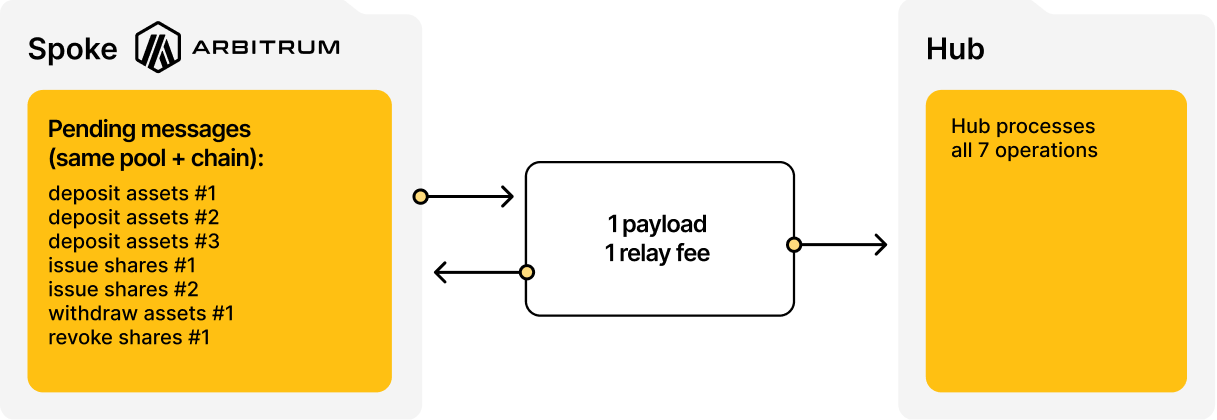
Centrifuge batches automatically. Multiple cross-chain messages are grouped into a single payload with a single set of proofs. A day's worth of deposit fulfillments, share transfers, and price updates can settle in one batched transaction rather than dozens of individual relays.
Batching is nestable. Multiple contracts can compose operations within the same batch without worrying about whether a sub-call already started its own. The protocol tracks nesting depth and only sends when the outermost batch completes. For builders, the interface stays the same whether the vault serves 5 investors or 5,000.
Cost estimates and gas subsidies
Cross-chain operations have variable costs. Builders and managers need to know what an operation will cost before committing to it. Every adapter provides an estimate function that returns the expected cost of a cross-chain message based on current conditions, so managers can budget accurately and builders can surface costs to users.
For institutional investors, holding native gas tokens on every chain just to pay for vault interactions is an operational burden. Centrifuge solves this with gas subsidies. Each pool has a dedicated escrow that managers can fund with native tokens. Cross-chain gas costs are drawn from the escrow, so investors interact with vaults using only their deposit asset.
If a message is sent without sufficient gas the protocol queues it and anyone can fund it later. Cross-chain operations are resilient to temporary gas gaps rather than failing permanently.
Distribution is the product
The value of a tokenized fund is significantly impacted by where it can be accessed. A treasury fund on Ethereum mainnet that's also available on Base, Arbitrum, and Optimism doesn't just reach more investors. It becomes eligible for more DeFi integrations, more protocol treasuries, more automated strategies.
Centrifuge's multichain architecture makes distribution a single deployment step, not a multi-month engineering project. A fund manager clicks once, and a new spoke is provisioned with share tokens, escrows, and vault contracts on the target chain. The hub handles cross-chain accounting and settlement automatically. Adding a tenth chain works the same as adding the second. Builders integrate with a standard vault interface on whichever chain their users are on.
Multichain operations also need multichain observability. Centrifugescan is the first cross-chain explorer built for tokenized assets. Rather than checking five different block explorers, managers and builders track cross-chain message lifecycle, investment flows, and vault state across every spoke in a single view.
Centrifuge is currently available on Ethereum, Base, Arbitrum, Solana, Stellar, BNB Chain, Avalanche, Plume, Optimism, Hyperliquid, Monad and Pharos.


Ready to get started?
Centrifuge’s real-world asset tokenization platform brings the full power of onchain finance to asset managers and investors.


