
Centrifuge V3.1: From Tokenization to Onchain Asset Management
By Jeroen Offerijns, Co-Founder & CTO, Centrifuge Labs
Centrifuge V3.1 is live. It's the result of years building toward a single goal: a protocol where tokenization is the entry point, and asset management, accounting, distribution, and controls all run onchain from there.
V3 shipped modular fund infrastructure, chain abstraction, and composability through ERC-7540 and ERC-4626. V3.1 takes those capabilities to production scale.
Why V3.1: Infrastructure for real-world asset tokenization
Every builder in this space faces the same problem. They deploy their own tokens, oracles, whitelisting logic, order management. Each implementation is bespoke, isolated, and expensive to maintain. That work absorbs engineering capacity that should go toward building differentiated products.
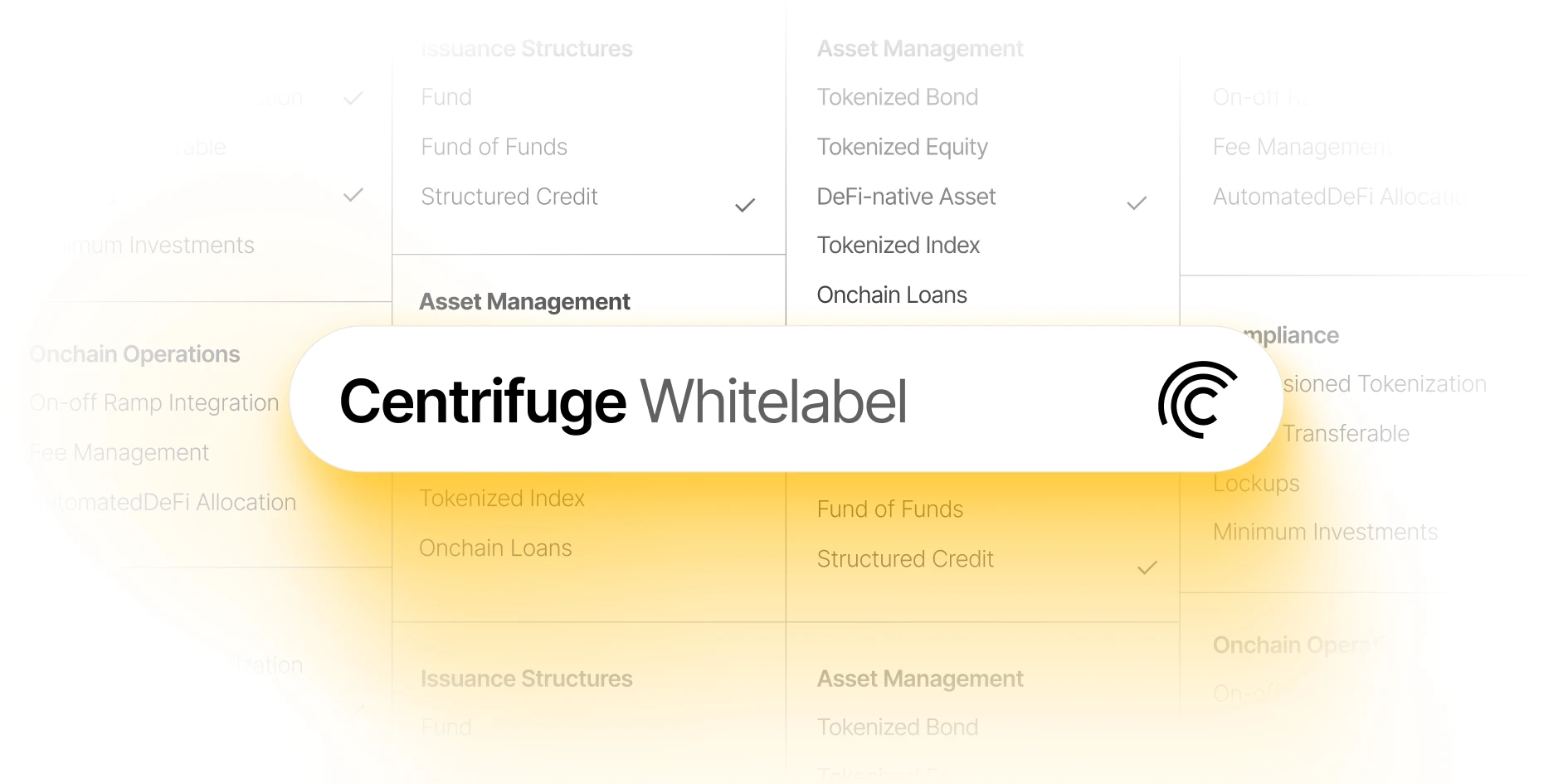
Centrifuge has spent eight years solving these exact problems. V3.1 strengthens Centrifuge Whitelabel, our platform for any builder or financial institution to launch tokenized products using the same audited rails trusted by institutional fund managers. Builders configure what they need, plug in their own modules where it matters, and skip months of redundant smart contract work.
This matters for security, too. Bespoke deployments carry real risk. Centrifuge's core contracts have been through 20+ security reviews. Reusing battle-tested infrastructure is both faster and safer.
Onchain accounting for tokenized assets
Most tokenized assets today work the same way. An asset exists offchain. A fund administrator calculates the net asset value. That number gets pushed onchain as a price feed. The token reflects whatever the oracle says.
That model creates full dependency on offchain data with limited transparency for investors. It doesn't take advantage of what blockchains are actually good at: verifiable, real-time state.
V3.1 enables a full onchain accounting system based on double-entry bookkeeping. When investments come in across multiple chains, the system debits asset accounts and credits equity accounts on the hub. The NAV Manager recomputes the fund's net asset value directly from that onchain state. The Price Manager derives the share price and pushes oracle updates to every chain where the token is deployed.
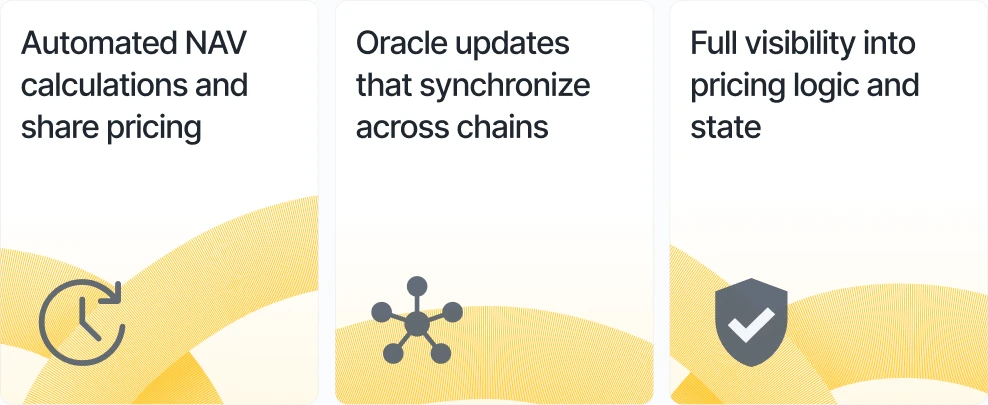
In practice: an issuer managing an investment fund could hold stablecoins on one chain, LP positions on another, and private credit assets on a third. The protocol aggregates those balances into a single bookkeeping state, computes the NAV, prices the shares, and distributes that price across every deployment. No offchain calculation agent required.
This is the shift from asset tokenization meaning just issuance to actual onchain asset management. The blockchain becomes the system of record and the distribution layer at once.
Multichain that actually scales
Centrifuge's hub-and-spoke architecture has powered multichain distribution since V3: each manager selects one hub chain as their source of truth, while tokens and vaults deploy across spoke chains. V3.1 expands support from 6 to 10 networks: Ethereum, Base, Arbitrum, Avalanche, BNB Chain, Optimism, HyperEVM, Plume, Monad, and a tenth on the way.
A Whitelabel partner can now launch across any of these with a single action, reaching investors wherever they are.
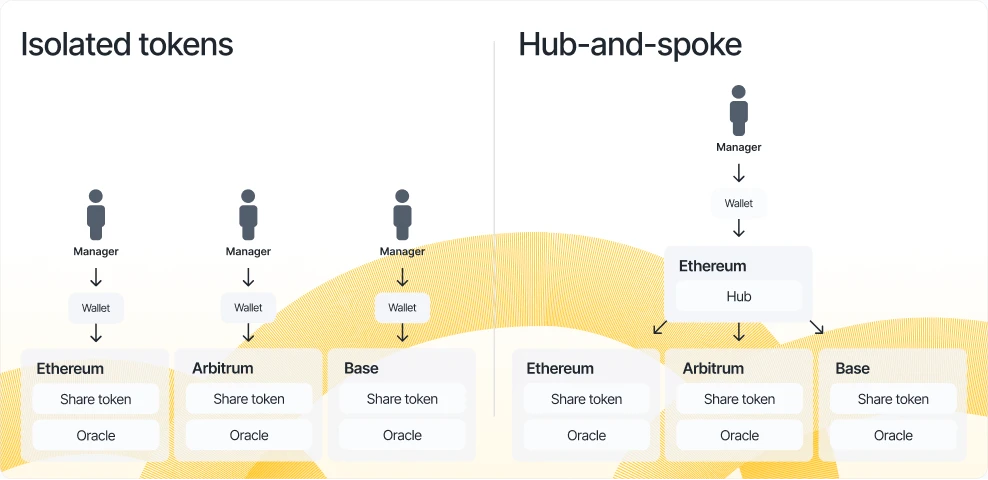
Where most multichain implementations break down is the operational overhead. A fund deployed across 10 networks would normally require 10 separate price update transactions, gas management on each chain, and monitoring across all of them. V3.1 introduces cross-chain batching: a single transaction on the hub triggers updates across every spoke automatically. The protocol handles gas subsidies and includes built-in retry logic for failed messages.
These features come from years of running multichain products in production and learning what actually breaks.
Modularity that serves builders
V3.1 introduces plug-and-play modules across the stack. Builders can customize how orders are managed, how redemptions are processed, how compliance is enforced, and how collateral is handled. The core protocol stays immutable and audited. The configurable layers adapt to each builder's needs.
Daylight, a decentralized energy infrastructure project, was the first partner to build on Centrifuge Whitelabel. They didn't want to rebuild tokenization, cross-chain distribution, and investor management from scratch. They wanted to solve their specific problem: managing redemptions and distributing cash flows from long-duration energy assets. Centrifuge's modular architecture lets them build a custom redemption module on top of the audited core, without touching the base infrastructure.
Centrifuge handles the rails. Builders handle what makes their product unique.
Centrifugescan as the visibility layer
Running tokenized products across multiple chains creates a visibility problem. Block explorers show raw events per chain. They don't reconstruct intent, route, and state across chains.
Centrifugescan tracks every cross-chain action, from price updates to mints to redemptions, showing what started, where it's headed, and whether it completed or failed, with the reason in clear terms. Asset managers get audit-ready reporting. Allocators can verify cross-chain behavior in production. It's the operational layer that turns a multichain protocol into something a team can actually run.
Building the rails for onchain finance
The tokenization race isn't about who tokenizes the most assets. It's about who builds the infrastructure that financial institutions and builders run on.
With onchain accounting, cross-chain batching, modular fund architecture, and full multichain visibility, Centrifuge now supports the complete lifecycle of real-world assets natively onchain, from issuance through pricing, reporting, and DeFi integration.
More to come as partners ship new products on V3.1. This is the foundation. The interesting part is what gets built on top of it.



Ready to get started?
Centrifuge’s real-world asset tokenization platform brings the full power of onchain finance to asset managers and investors.


