
Inside Centrifugescan: Cross-Chain Transaction Monitoring for Tokenized Assets
Why we built it, what you can see today, and how it works under the hood.
By Jeroen Offerijns, Co-Founder & CTO, Centrifuge Labs
When you run a tokenized product on multiple chains, the simplest question can become the hardest to answer: Where is the transaction now, and what actually happened? A price update originates on Ethereum, propagates to Base, a redemption leg is settling on Avalanche, and an allocator wants confirmation before close. Without the right view you’re juggling explorers, tracing bridge hops, and paging an engineer. That’s the gap Centrifugescan closes.
What breaks in multichain (and why explorers aren’t enough)
Single-chain tools miss broader context. Tokenized real world assets in 2026 need to be multichain from day one. A live product mints and burns on different networks, syncs pricing, moves allocations, and enforces access rules per network. Traditional explorers show raw events per chain, they don’t reconstruct intent, route, and state across chains or explain failure reasons in product terms. That’s the critical information asset managers and allocators need.
What Centrifugescan gives you
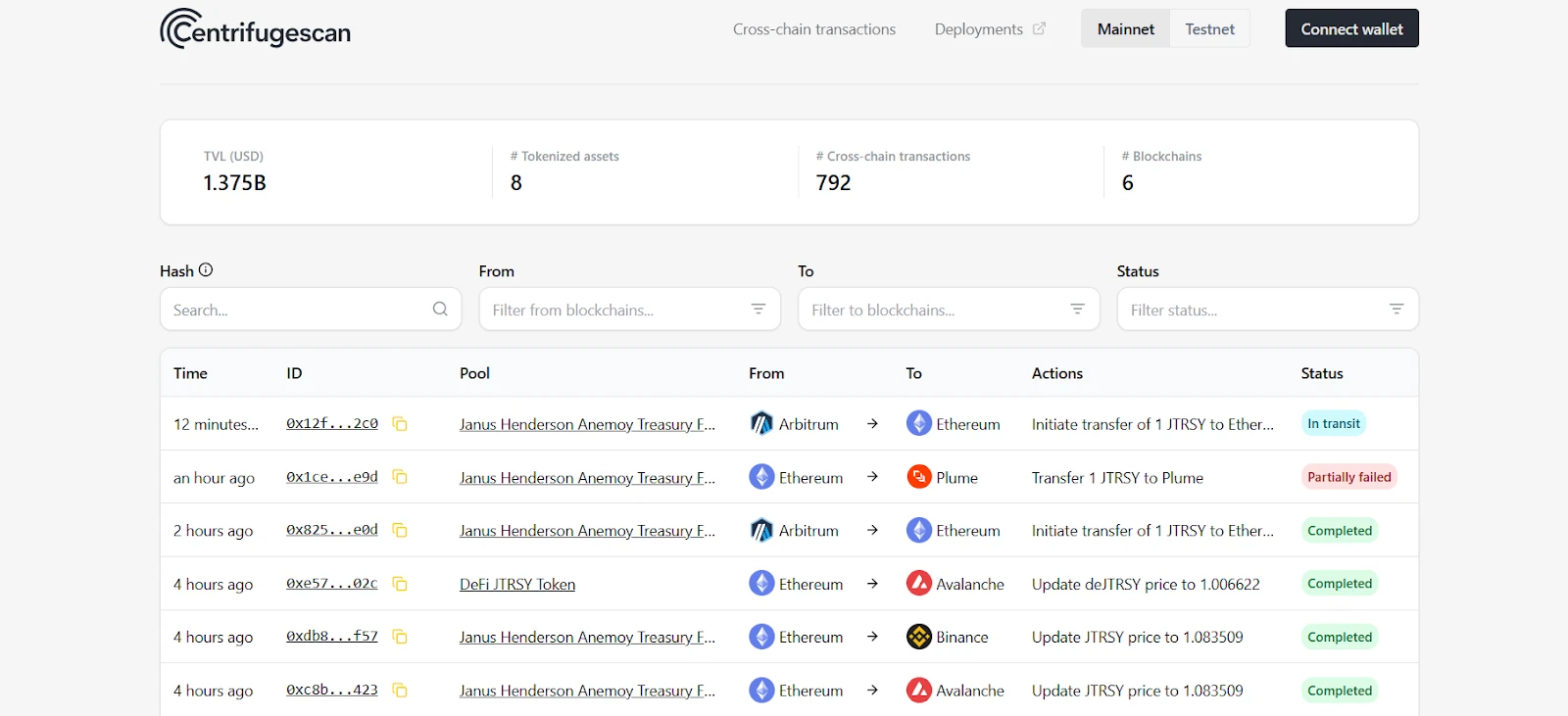
One place to track intent → route → state. Every action, price update, mint/burn, subscription, redemption, allocation movement, shows where it started, where it’s headed, and whether it’s completed, in transit, or failed (with the reason, in clear terms).
Overview panel for health. At a glance: track TVL, number of tokenized assets, total cross-chain transactions, active chains. It’s the quick “is everything behaving?” check before you dive deeper.
Activity stream with filters. For each row you see pool, source chain, destination chain, action (“Update price,” “Mint,” “Allocation change,” etc.), status, and timestamp. Filter by pool, origin/destination, or status to jump straight to exceptions.
Direct, self-serve access. You can connect a wallet and monitor mainnet activity. No internal dashboards, no support tickets.
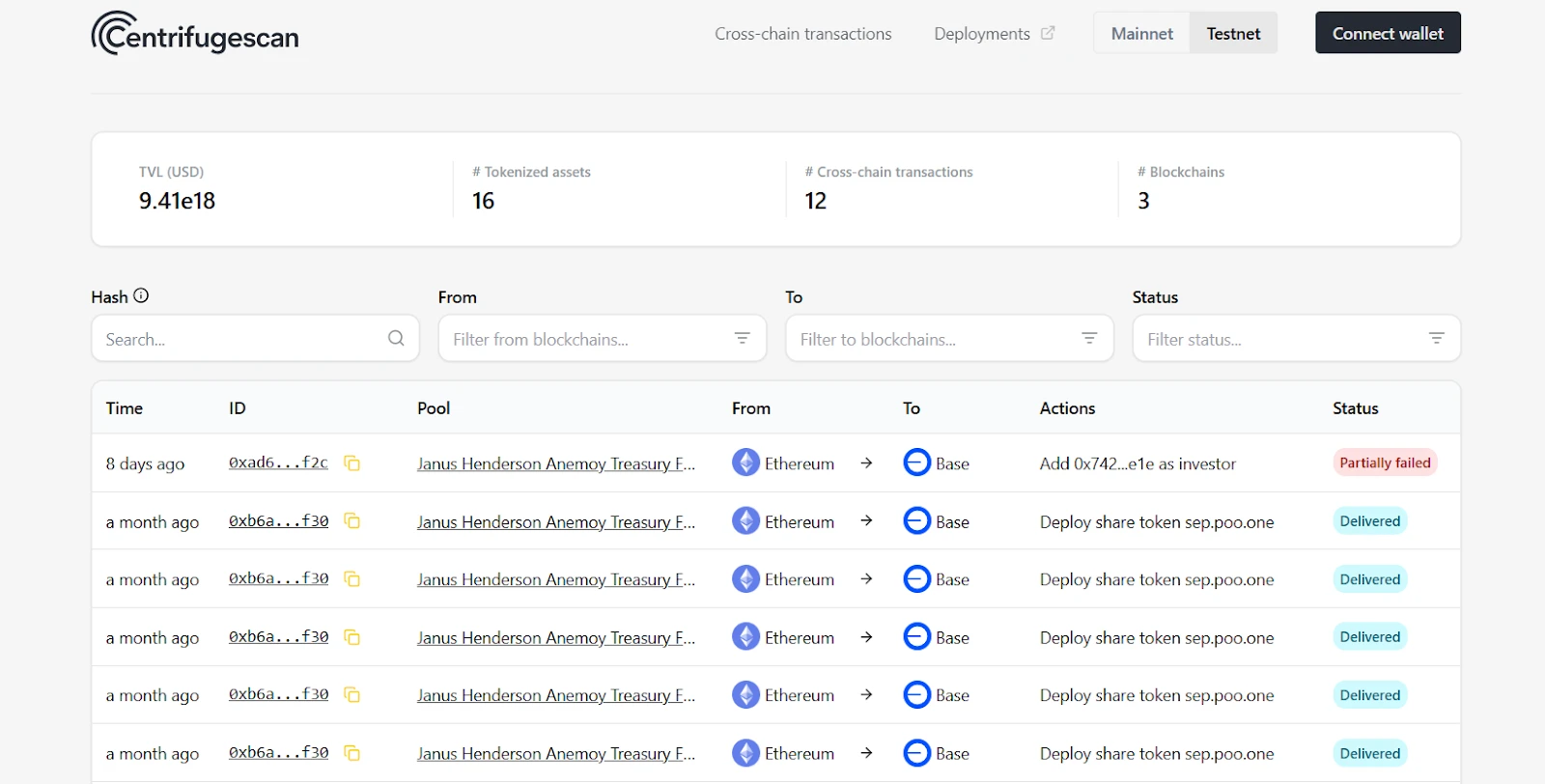
Practical example. A price update for a treasury pool originates on Ethereum. Centrifugescan shows it queued, then delivered to Base and Avalanche. If a leg fails because of a bad parameter, you see which leg and the value that caused it, so you correct the input, not guess.
Result: fewer “can someone from protocol jump on this?” messages and faster, auditable resolution.
How it works under the hood
Event ingestion & normalization. We consume onchain events from supported networks and store them in the Centrifuge API (vaults, pools, shares, price updates, subscription/redemption legs).
Cross-chain correlation. Actions are stitched into a single record with legs per chain. That record is what you see: one action, multiple legs, one status.
Status machine. Initiated → In transit → Delivered with explicit failure states: Partially failed (some legs delivered), Failed (no legs delivered). We also surface common root causes (parameter mismatch, insufficient allowance/liquidity, finality lag).
Chain abstraction. Centrifuge runs multichain by design. Centrifugescan reflects that abstraction: the product is the unit of truth, chains are venues. You don’t need to know which bridge or relayer handled a hop to understand the product’s state.
What this changes for teams
Asset managers / issuers. The entire team gets transparency and a clear, product-level view: where tokens are deployed, what moved, what finalized, what failed and why. That’s audit-ready reporting without exporting logs.
Allocators. You can verify behavior across chains in production: the asset exists, is maintained, and state syncs. Diligence moves faster when you can observe the thing you’re funding.
Centrifugescan is asset-aware. Open a pool and you’ll see where it’s deployed, which chains it touches, and every related cross-chain event in one thread. You’re inspecting the product you run, not hunting contract addresses across explorers. That’s the view partners, service providers, and builders actually need.
Where Centrifugescan sits in the stack
Centrifuge is end-to-end onchain asset infrastructure — rails that meet institutional requirements and stay DeFi-native.
- Protocol rails & extensions. Reusable contracts for real world asset tokenization, vaults, subscriptions/redemptions, access controls, pricing, and onchain accounting — audited and battle-tested on mainnet since 2019 with 20+ security reviews and no exploits to date.
- Standards-first design. ERC-7540 and ERC-4626 so vault shares and yield positions compose with decentralized finance from day one (lending, treasuries, liquidity programs) without custom wrapping.
- SDK & API. Build your own frontend under your brand, or automate operations without standing up an indexer and monitoring stack.
- Embedded access controls & audit-ready reporting. Eligibility, onboarding rules, reporting hooks, and accounting data are part of the rails.
- Centrifugescan. The visibility layer over all of the above: real-time, multichain, understandable by non-engineers.
Put simply: tokenize, launch multichain, run investor flows, and prove what happened, without stitching together five explorers.

Ready to get started?
Centrifuge’s real-world asset tokenization platform brings the full power of onchain finance to asset managers and investors.


