
Research: What 150 Operators Said About the State of Tokenization
Everyone has a thesis on what tokenization needs to break through. More assets. Better rails. Clearer regulation. Between February and March 2026, we surveyed 150 operators across issuance, distribution, liquidity, and infrastructure to ask what the people building this market actually believe.
Some of it confirmed the consensus. Most of it didn't. Three findings stood out.
1. The US is more confident than Europe in near-term growth.
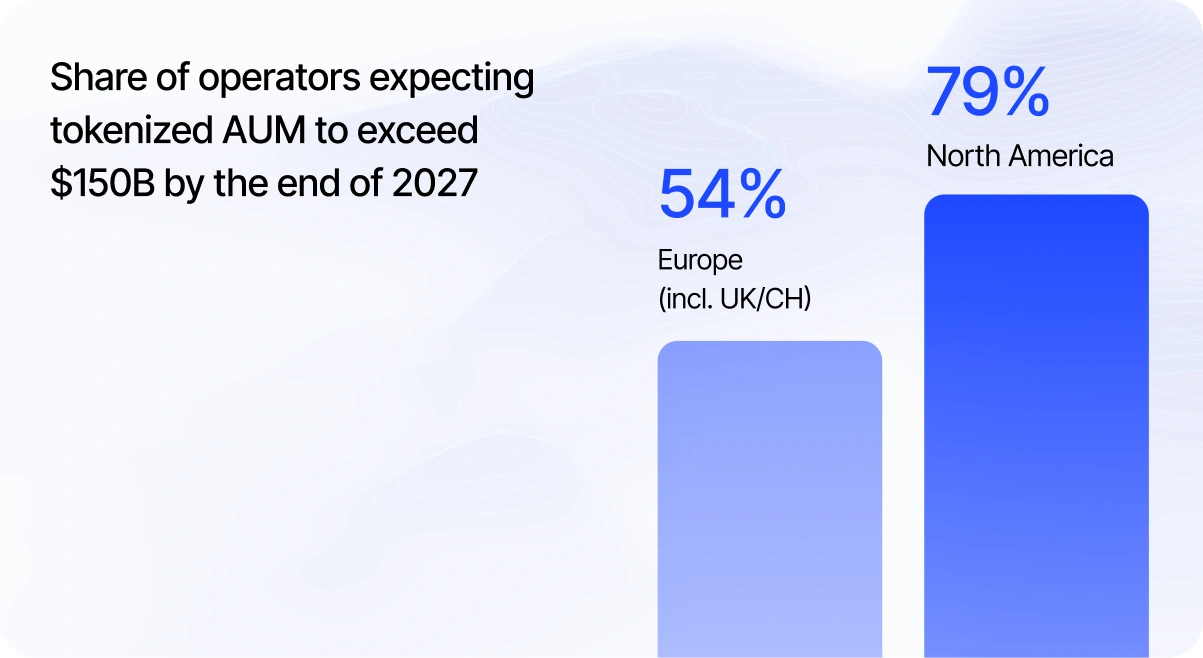
The headline number is the divergence. 79% of North America-based operators expect tokenized AUM to exceed $150B by end-2027. In Europe, including the UK and Switzerland, the figure falls to 54%. The broader distribution adds context. Half of all respondents place 2027 AUM in the $150B–$500B range, and 80% cluster between $50B and $500B. The market is converging on meaningful growth. The disagreement is about pace.
The gap reflects different on-the-ground conditions, not different convictions. North America is pricing in regulatory momentum and a concentrated wave of institutional entries. Europe is taking a more measured view. Same trajectory, but different speed assumptions. Where operators sit shapes what they see coming.
“It is not surprising that US operators are more bullish on tokenization. Tokenization today is still largely a dollar story, and stablecoins have become a Trojan horse for global demand for US debt and dollar-based financial rails. Europe has delivered regulatory clarity through MiCA, but the framework has so far felt more restrictive and cautious than growth-oriented, which helps explain why US operators appear more bullish.”
Eric Manoukian, Research Analyst, Messari
2. The race to tokenize every existing asset is the wrong race
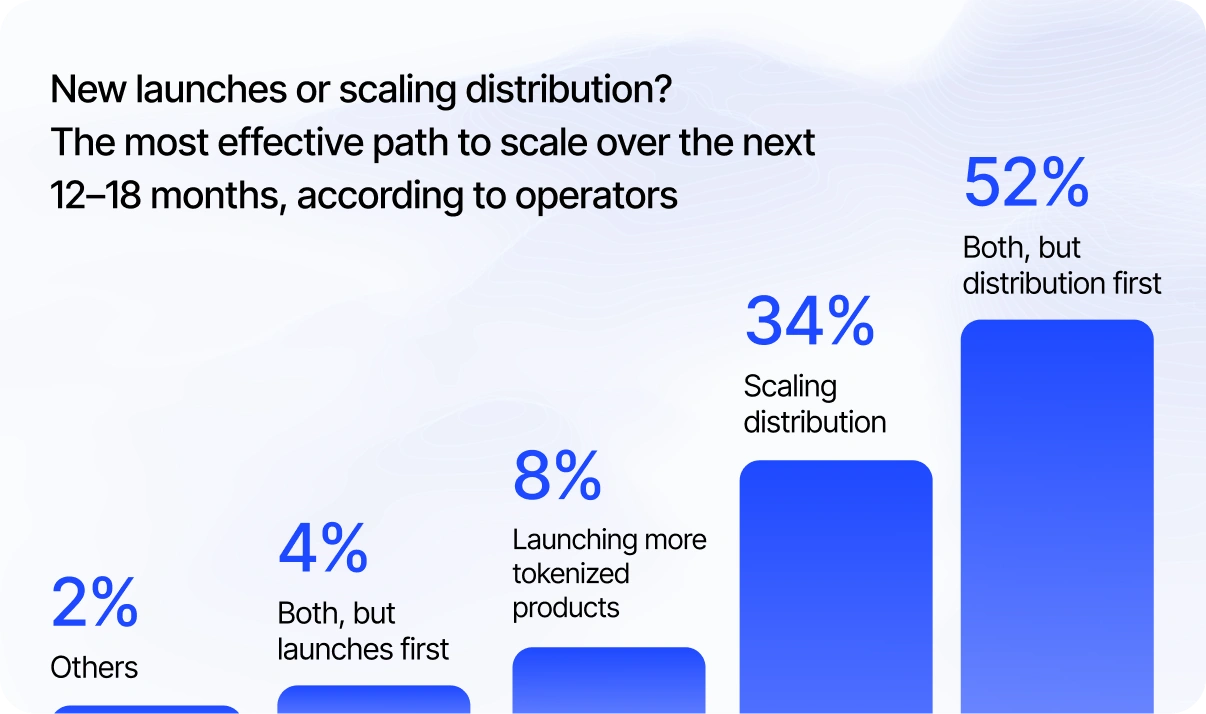
86% of operators say distribution, not new product launches, is the priority for the next 12 to 18 months. 52% say both matter but distribution comes first. 34% say scaling distribution for existing products is the more effective path on its own. Only 8% put new launches first. That is the widest point of consensus in the entire survey, holding across company size, geography, and operator type.
The supply side has matured. The question is no longer whether tokenized products can be launched, but how they reach the right hands, wallets, and venues. Even among the small group prioritizing more issuance, liquidity is still cited as the main concern. New launches are mostly seen as a way to improve market depth and product fit, not as an end in themselves.
“86% saying distribution matters more than issuance makes sense when you look at onchain data. Every time a curator builds a new leverage strategy around an RWA on Morpho, or Centrifuge's JAAA gets listed as Horizon collateral, the asset becomes more useful and productive, which makes it easier to distribute. Utility accelerates distribution.”
Filippo Armani, Research Lead, Dune
3. Programmability is the emerging differentiator
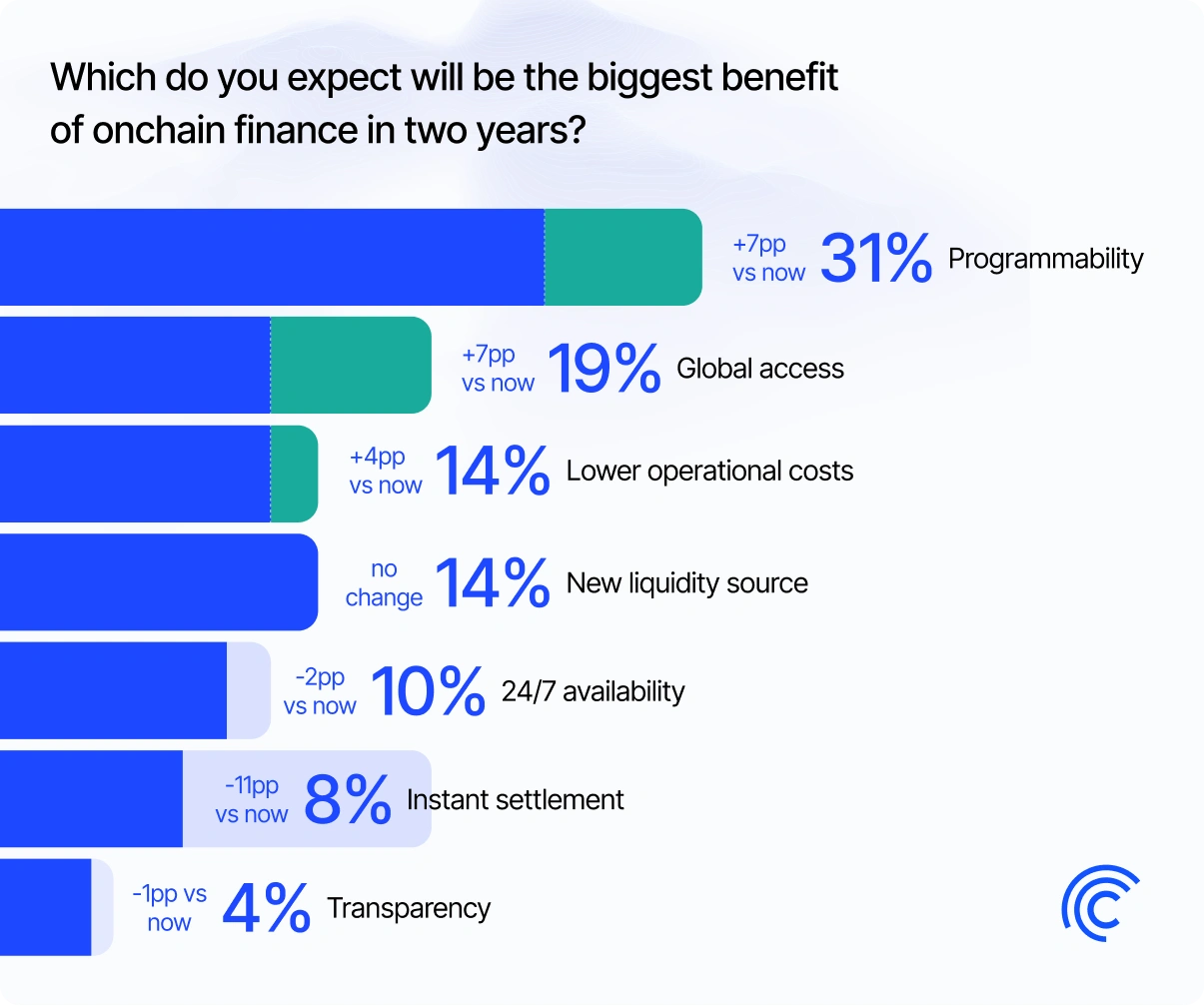
Programmability rises to 31% as the top projected benefit of onchain finance two years from now, up seven points from today. Global access moves up seven points to 19%, becoming the second-largest projected benefit. Settlement speed moves in the opposite direction, falling from 19% to 8%. That is the sharpest decline of any benefit in the survey. The features that defined earlier tokenization narratives are being repriced.
The pattern is consistent. The advantages still valued in two years are structural. The ones losing ground are operational. Settlement speed and 24/7 access helped define the early case for tokenization, and they still matter. They are becoming expected, not differentiating. The value ahead is in what happens after tokenization, not in the act of issuing itself.
“Every tokenization platform we work with tells us the same thing: making tokenized assets productive is now their number one priority. This report confirms what we're hearing on the ground. Tokenization is step one: it opens the door. Making those assets productive onchain is step two, where the real value gets unlocked.”
Merlin Egalite, Co-Founder, Morpho
The full report goes deeper: regulation, liquidity, investor confidence, and what builders actually expect from the infrastructure layer. Read it here: Tokenization Outlook 2026




Ready to get started?
Centrifuge’s real-world asset tokenization platform brings the full power of onchain finance to asset managers and investors.


